Cryptocurrency arbitrage is based on price differences in the same asset or related instruments. In a simple cross-exchange example, an asset is bought where the available price is lower and sold where it is higher. The outcome depends on executing both trades: after fees, transfers and price changes, the visible spread may almost disappear or turn into a loss.
Crypto arbitrage can be cross-exchange, within one exchange or triangular. Spot positions paired with perpetual contracts and P2P transactions are considered separately. Each approach has its own costs and constraints. The main calculation here covers two unleveraged spot trades.
We will compare the approaches, read order books and calculate two outcomes for a hypothetical transaction. The public-market screenshots illustrate how to read the interfaces. The example prices and fees are specified separately and do not represent an offer available now.
- Buy price: examine sellers' orders, the ask side, and the quantity available at those prices.
- Sell price: examine buyers' orders, the bid side, for the other leg of the trade.
- Costs: account for both trades, moving funds and restoring the starting balances.
- Execution: consider what happens if one leg is delayed or only partially filled.
Types of crypto arbitrage: costs and risks compared
| Approach | What is compared | What to include in the calculation |
|---|---|---|
| Cross-exchange spot | Buying and selling an asset on different platforms | Two executions, fees, transfers and remaining balances |
| Triangular | A sequence of three conversions | Order-book sides, three fees and rounding |
| P2P | Payment terms with counterparties | Payment method, limits, timing and checks |
| Spot and a contract | An asset and an opposing position | Basis, collateral, fees and funding |
The strategy's name does not determine its risk. Buying and selling on two platforms requires available funds, working deposits and withdrawals, and compatible networks. Trading within one platform reduces the number of transfers, but trading fees and the risk of executing each leg remain.
Which price should you compare: the last trade, ask or bid?
The large number beside a trading pair often shows the last completed trade. The next purchase may execute at a different price. To assess immediate execution, open the order book: sell orders are usually shown above and buy orders below.
Ask tells you the price at which someone is currently offering to sell. For a buyer, this is the opposite side of the trade. Bid shows the price someone is willing to pay, so it is used to assess your own sale. Comparing two last-traded prices instead of available asks and bids may reveal a spread that cannot actually be captured.
Why quantity matters as much as the first price level
The best price applies to a limited quantity. If you need to buy more than the first level offers, execution reaches subsequent levels and the average price changes. The same applies to selling: a large quantity may fill against several buy orders.
Suppose 30 units of a hypothetical asset are available at 10.00 USDT and another 70 at 10.03. Buying 100 units costs 30 × 10.00 + 70 × 10.03 = 1,002.10 USDT. The average price is 10.021. Using the first level's 10.00 for the whole purchase would understate costs by 2.10 USDT before trading fees.
Our separate guide to spot trading on Bybit explains the trading process. An arbitrage comparison requires the same execution data, but for both sides of the proposed transaction.
Two BTC/USDT order books: reading real trading screens
The screenshots show the public Bybit and Binance spot markets for the same BTC/USDT pair. They were captured in November 2026 less than a second apart. Even over that interval, the interfaces update independently and orders may disappear before you execute a trade.
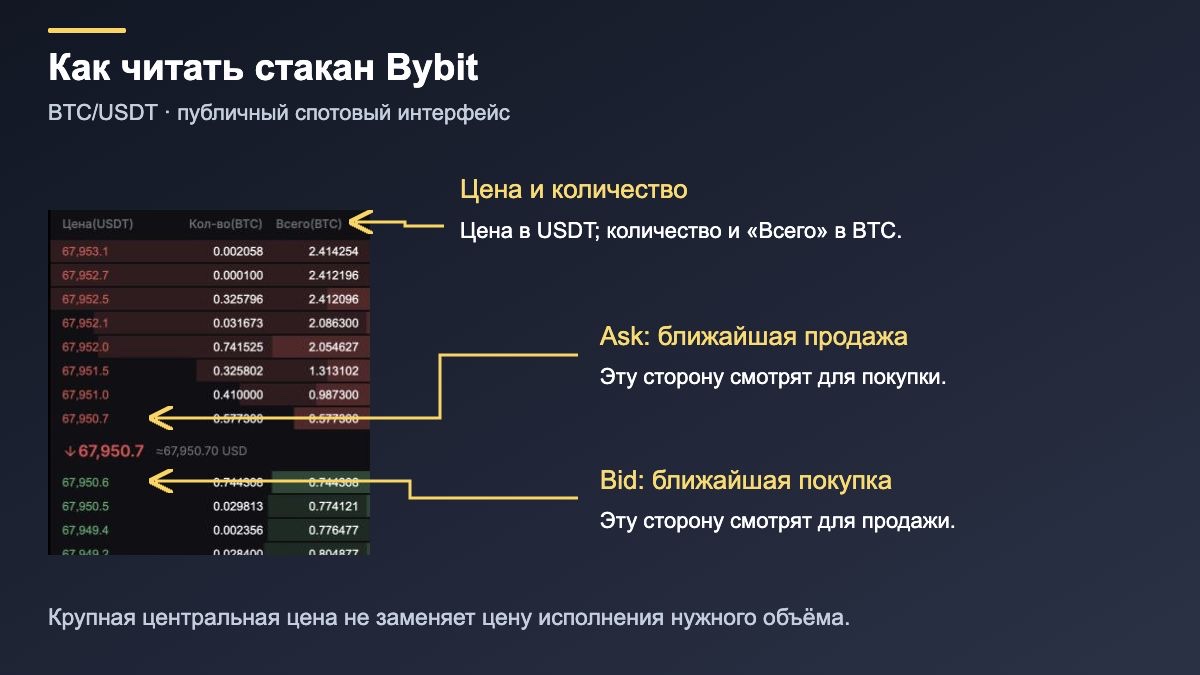
The Bybit order book highlights the nearest sell and buy offers and their BTC quantities. The central row displaying a large price is separate from those orders: it cannot automatically be treated as the buy or sell price for your required quantity.
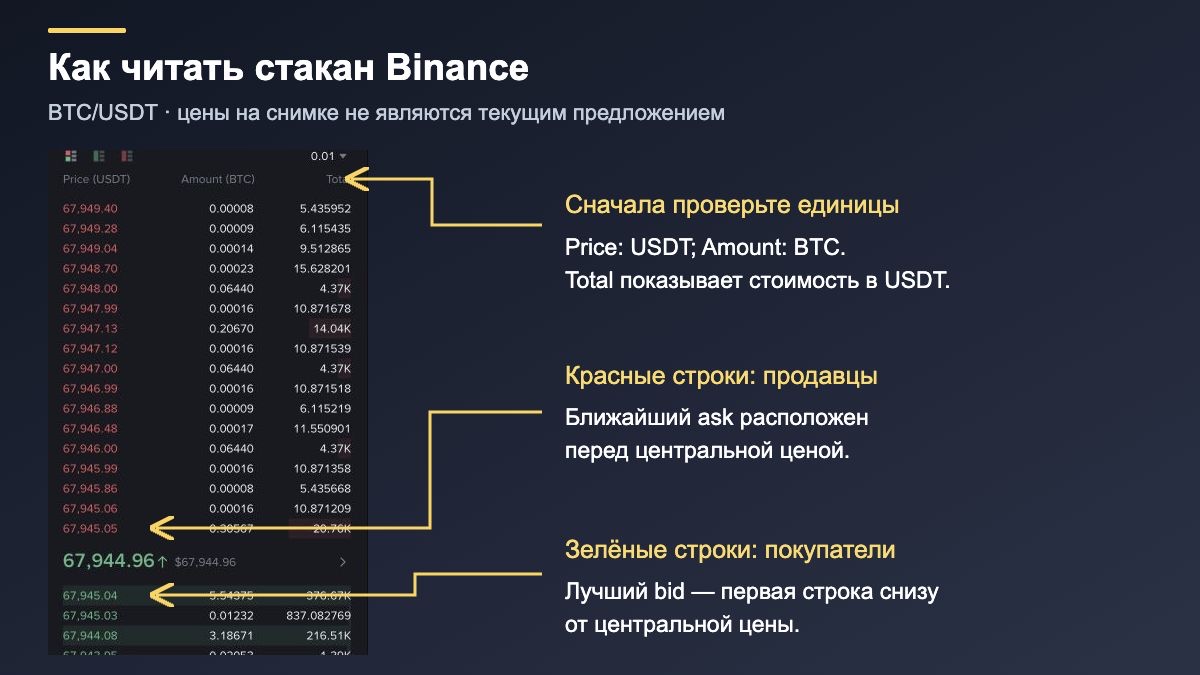
Check the same fields on Binance. Alongside price and quantity, examine the unit used in the total column: these screens present cumulative volume or value differently. Do not compare numbers in Total columns without checking their units.
We do not use these images to calculate returns between the platforms. That would also require current account-specific fees, available quantity, deposit and withdrawal conditions, crediting times and the ability to execute both legs. A screenshot records an observation; it does not reserve an order.
How to calculate arbitrage after fees
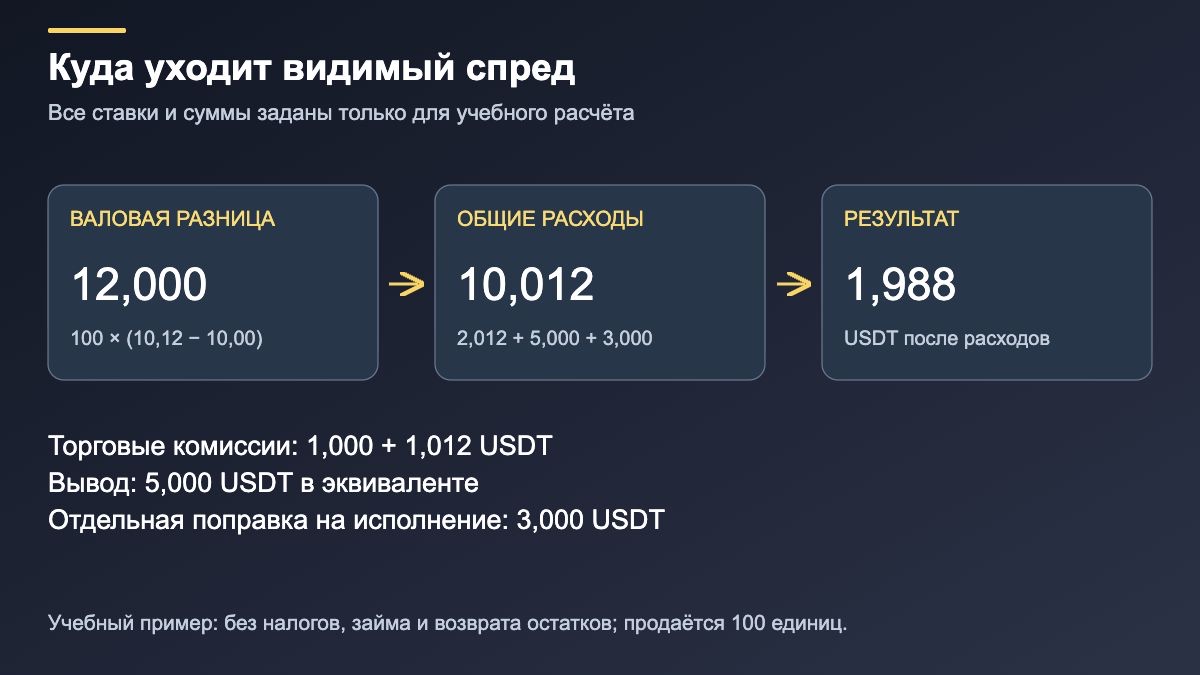
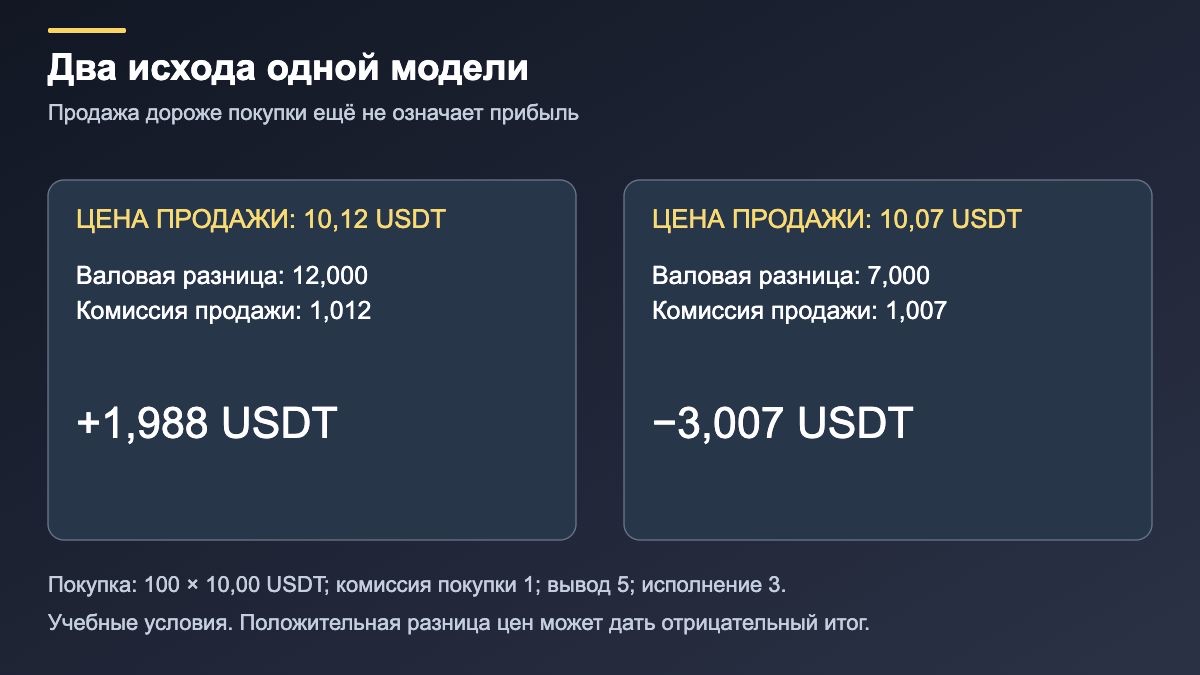
Take a hypothetical asset X. We buy 100 units at 10.00 USDT and sell the same 100 units at 10.12 USDT. The gross difference is 12.00 USDT, or 1.2% of the purchase value. We then deduct costs not already included in those prices.
For this example, set trading fees at 0.1% on each side, the transfer cost at the equivalent of 5.00 USDT, and a separate slippage allowance at 3.00 USDT. The quantity sold remains 100: purchase and withdrawal costs are paid separately in this model. Taxes, borrowing and the cost of restoring balances are excluded for now.
| Example calculation | USDT |
|---|---|
| Purchase: 100 × 10.00 | 1,000.000 |
| Sale: 100 × 10.12 | 1,012.000 |
| Gross difference | 12.000 |
| Buy fee: 0.1% | −1.000 |
| Sell fee: 0.1% | −1.012 |
| Withdrawal cost, equivalent value | −5.000 |
| Separate execution allowance | −3.000 |
| Result before taxes, borrowing and rebalancing | 1.988 |
Result: 12 − 1 − 1.012 − 5 − 3 = 1.988 USDT. About 0.199% of the purchase value remains from the original spread. This is the outcome of the specified hypothetical conditions and will fall further if additional costs arise.
How to avoid counting slippage twice
In this example, 10.00 and 10.12 are reference prices, with worse execution accounted for on a separate line. If you have already calculated average buy and sell prices across the available order-book levels, the corresponding quantity effect is included in those prices. Do not deduct the same effect again as a separate cost.
Once the trades are complete, use actual sale proceeds, actual purchase costs and fees from the execution history. Comparing these with the initial estimate shows how market movement, quantity and delay affected the result. A single final number without that breakdown does little to explain a calculation error.
Where is the break-even point?
Holding the table's 10.012 USDT of costs fixed for 100 units requires a price difference of about 0.10012 USDT per unit. The visible spread must cover at least that amount. A margin of a few thousandths can easily be consumed by rounding, delay or another fee.
This approximation keeps costs unchanged. If the sell fee is 0.1% of the new proceeds, it must also be recalculated. With the example's other assumptions unchanged, the exact break-even selling price is approximately 10.10010 USDT. For a real assessment, recalculate the entire cash flow rather than relying on a universal “sufficient percentage”.
What happens if the selling price deteriorates?
Suppose the available price falls to 10.07 USDT by the time you sell. Proceeds from 100 units are 1,007 USDT and the gross difference falls to 7 USDT. At the same fee rate, the sell fee is 1.007 USDT; the other assumed costs stay unchanged.
New result: 7 − 1 − 1.007 − 5 − 3 = −3.007 USDT. The selling price is still 0.07 USDT above the purchase price. Yet the combined trades now produce a loss. Saying “I bought it cheaper” tells you very little about final profit without the full calculation.
Which asset pays trading and withdrawal fees?
Do not assume that every cost is deducted in USDT. Some fees reduce the quantity of the coin purchased; others are deducted from sale proceeds or a separate balance. Withdrawals may have their own fee asset, minimum and method of calculating the amount received.
For example, the Bybit spot-fee guide ties the trading fee's denomination to the cryptocurrency being acquired. When buying BTC with USDT, this affects the amount of BTC received. Rates also depend on account level and region, so do not substitute the example's 0.1% for your own terms.
- Purchase: record the asset spent and the quantity actually received.
- Withdrawal: establish whether the fee is deducted from the amount sent or paid separately.
- Sale: calculate the quantity actually available to sell after previous deductions.
- Balances: include the cost of restoring them to a state from which you can assess the next transaction.
Our Bybit fees guide covers one platform in detail. If an exchange service is involved, also compare the final amount received using our guide to cryptocurrency exchange rates.
Why arbitrage opportunities disappear
Time passes between observing a price and completing the transaction. A deposit may wait for confirmations, a platform may suspend a network, and available orders may change. If you buy the asset first and then move it to another exchange, the selling price remains unknown until execution.
Keeping funds on both platforms in advance allows you to consider executing the trades without waiting for a transfer between them. However, capital is then spread across services, either leg can still be only partially filled, and the balances will eventually need rebalancing. That stage's costs and risks are also part of the strategy.
- Partial fills. One leg executes only part of the quantity, leaving an unplanned position.
- Minimums and rounding. A remainder may fall below the minimum order or withdrawal size.
- Network incompatibility. Matching tickers do not establish that the asset and deposit method are the same.
- Account restrictions. Verification, a limit or a transaction review can affect access to funds.
- Delayed data. A scanner and a trading screen may represent different moments in the market.
A limit order caps the acceptable price but does not promise a full fill. A market order takes available liquidity and is exposed to changes in its average execution price. Special slippage-control modes may leave quantities beyond the specified limit unfilled. Check the actual outcome in the trade history.
Triangular arbitrage, P2P, and spot versus futures
Several pairs on a single exchange
A triangular strategy makes three conversions and returns to the starting asset. It requires a sequence of executable prices in the correct directions: where the asset is bought, where it is sold, and how each pair is quoted. Multiplying attractive numbers from a quote list may ignore the order-book sides, three fees and rounding at each step.
P2P and counterparty payments
In P2P, price is only part of the calculation. Listing terms, accepted payment methods, deadlines and confirmation that money has actually arrived also matter. Bank payments and cryptocurrency transfers each have their own stages. Our P2P exchange guide explains the basics. A calculation for two spot orders cannot simply be carried over to this format.
Spot and a perpetual contract
When combining a spot asset with an opposing contract position, account for the price difference, trading costs, collateral and funding. Funding is a separate payment between participants in a perpetual contract. It may generate income or a cost depending on the rate's sign and the side of the position.
The official Bybit funding-fee explanation states that intervals depend on the trading pair and that payment applies to a position open at settlement. Do not extrapolate the current rate over a year as if it were fixed. A margined position also carries liquidation risk, even when a spot asset is held alongside it.
What to check before assessing an arbitrage trade
A useful calculation can be reproduced. Save the pair, observation time, quantity and original order-book levels. Record account terms and costs in the currencies in which they are actually charged. Converting every cost into USDT should involve a clearly stated conversion rate.
- Do the asset, contract and supported network match on both platforms?
- Is enough quantity available at the prices used in the calculation?
- Which maker or taker fees will apply to the actual fills?
- Are the required deposits and withdrawals working, and are minimums and limits satisfied?
- What position remains if either leg is partially filled?
- What will it cost to close the remainder and restore the original distribution of funds?
If a material cost is still unknown, leave it as a separate unresolved line. A zero in a table normally reads as “no cost”, even when it really means that the condition has not yet been checked.
Crypto arbitrage FAQ
Can you simply add the percentages from three consecutive conversions?
The final quantity requires sequential calculations. Each conversion uses the result of the previous one, including deductions and rounding. Adding percentages may provide a rough estimate, but does not replace calculating the quantity at each step.
Should a fee discount paid with a separate token be included?
Yes, but the value of the token spent is still a cost. Record its quantity and the rate used to value it. A smaller USDT deduction does not mean the trade was fee-free.
Why does profit in USDT differ from the result in roubles?
Conversion adds the exchange rate at the chosen time and conversion costs. Comparing two transactions requires a consistent valuation basis. A strategy's USDT trading profit and the roubles received after a separate withdrawal are different measures.
Does a maker order guarantee a lower fee?
The rate depends on the platform, pair and account level. Moreover, a limit order can execute immediately against an existing order and be treated as a taker fill. Check the trade's actual role in the history.
How should a scanner or trading-bot subscription be accounted for?
These are separate strategy operating costs. To assess a period, add them to trading costs using a chosen, consistently applied allocation method. A subscription does not turn an observed spread into guaranteed execution.