Microcredit companies (MCCs) and microfinance companies (MFCs) are two types of Russian microfinance institution. An individual borrower's outstanding principal with one MCC can reach RUB 500,000, compared with RUB 1 million at an MFC. The capital, funding and remote identity verification rules also differ. If you need RUB 10,000–20,000, the terms of the individual agreement usually matter most.
We explain the abbreviations, show how to look up a lender by its taxpayer number and walk through the cost of a loan. A public Bank of Russia record illustrates a change of status, and a worked example covers interest, total charges and early repayment.
This guide reflects the rules in force in November 2026. Changes scheduled for 2027 are marked separately. The companies mentioned serve as lookup examples. The editorial team did not apply for any loans.
- MFI is the umbrella term for both MCCs and MFCs.
- Check the company type in the Bank of Russia register, along with the taxpayer number, current authorisation and website address.
- Compare the cost using the total cost of credit, repayment amount, term and additional charges.
- A register entry confirms authorisation to operate. A favourable rate or approval still depends on the offer and application.
MCCs and MFCs at a glance
| Feature | MCC | MFC |
|---|---|---|
| Full name | Microcredit company | Microfinance company |
| Category | Microfinance institution | Microfinance institution |
| Individual's outstanding principal with one company | Up to RUB 500,000 | Up to RUB 1 million |
| Standard minimum equity | RUB 5 million, with statutory exceptions | RUB 70 million |
| Funds from individuals with no ownership stake | Prohibited | Allowed subject to statutory conditions. A standard loan agreement has a RUB 1.5 million minimum. |
| Mandatory annual audit under Law No. 151-FZ | No blanket requirement under this law. Other grounds may apply. | Required |
| Unified Biometric System in legally specified remote lending cases | Transition period until 1 March 2027 | Required since 1 March 2026 |
| How to verify authorisation | Bank of Russia register | Bank of Russia register |
The principal limits apply to individuals taking out consumer microloans. Business financing follows separate rules. The statutory cap is the maximum permitted, and the amount offered depends on the borrower. Bank of Russia comparison of MCCs and MFCs.
What do MFI, MCC and MFC mean?
An institution gains MFI status upon entry in the state register and issues microloans. Federal Law No. 151-FZ of 2 July 2010 provides the legal framework. Consumer loan terms are also governed by Law No. 353-FZ of 21 December 2013.
MFIs comprise microcredit companies and microfinance companies. “Microfinance institution” is the broader term. An MCC qualifies even if its name does not contain the word “microfinance”.
The website usually displays a brand. The contract identifies the legal entity by its full name, including its legal form, such as a limited liability company or public joint-stock company. A group can contain several entities, so check which one will actually be your creditor.
Write down the brand, the creditor's full legal name and its taxpayer identification number (INN), then check them against the contract and the register. An intermediary's website may only match users with offers and charge for that service. Signing a matching agreement does not confirm approval.
How the differences affect borrowers
Loan amount and outstanding principal
The RUB 500,000 and RUB 1 million caps cover outstanding principal under microloan agreements with the same lender. An existing debt with that lender reduces how much room remains under the cap for a new loan.
For example, if an MCC customer still owes RUB 420,000 in principal, another RUB 100,000 would take the balance over RUB 500,000. This calculation only establishes the legal ceiling. The lender may still decline a smaller request after assessing affordability.
Capital, supervision and audit
The standard equity minimum is RUB 70 million for an MFC and RUB 5 million for an MCC. Exceptions apply to some MCCs that finance businesses and companies with legally specified state or municipal participation. A smaller figure in a company's accounts alone is therefore insufficient to establish a breach.
Both types follow Bank of Russia requirements. MFCs face a broader set of prudential ratios and must undergo an annual audit and submit the auditor's report. Other audit legislation may require an MCC to obtain an audit even though Law No. 151-FZ has no blanket requirement for MCCs.
Who may raise funds from individuals?
An MCC may not raise money from individuals who are not its founders, members or shareholders. MFCs can do so subject to restrictions. Under a standard loan agreement the minimum from such an individual is RUB 1.5 million. Bonds are subject to separate statutory conditions.
These rules govern the company's funding. Borrowers do not pay RUB 1.5 million to qualify for a microloan. Assess the risks separately if an MFI offers to pay you interest for providing funds. Bank deposit protection does not automatically extend to those investments.
Online loans and biometrics
From 1 March 2026, MFCs must use the Unified Biometric System (EBS) when concluding remote agreements in cases specified by law. The transition period for MCCs ends on 1 March 2027. Check Article 9.2 of Law No. 151-FZ and how the particular agreement is concluded.
Sending a passport photo in a chat and using EBS are distinct procedures. If a service requests identification, check which legal entity performs it and where the data goes. Keep passwords, codes and account access out of correspondence with staff.
Microloan limits in November 2026
The daily rate determines interest accrual. The statutory total cost of credit (PSK) helps compare offers, and the cap on charges limits certain amounts under the agreement. Read each measure separately.
| Rule | What it means | Date and scope |
|---|---|---|
| Up to 0.8% per day | General cap on the consumer loan interest rate | In force. Certain short-term products have separate statutory conditions. |
| Charges capped at 100% of principal | Limits interest, penalties and other charges included by law | New agreements from 1 April 2026 with an original repayment term of no more than one year |
| Restriction on a third high-cost loan | A lender cannot issue a loan with PSK above 200% a year if the borrower has two outstanding loans or credits above that threshold | From 1 October 2026 |
| Tighter limits on high-cost loans | One loan with PSK above 100% a year and at least three days between repaying such a loan and taking another | From 1 April 2027. Not in force in November 2026. |
The Bank of Russia links the changes to the charge cap and the number of high-cost loans to Law No. 545-FZ of 29 December 2025. For an older contract, check the provisions that apply to it. An announcement of a lower cap does not automatically recalculate a loan already issued.
On a RUB 10,000 loan covered by the new rule, the relevant charges can reach another RUB 10,000. That is the ceiling. The actual interest can be much lower on a short loan repaid on time.
The repayment obligation continues after charges hit the cap. Late payments may appear in the credit history and lead to collection. Court costs and other claims depend on their own legal basis.
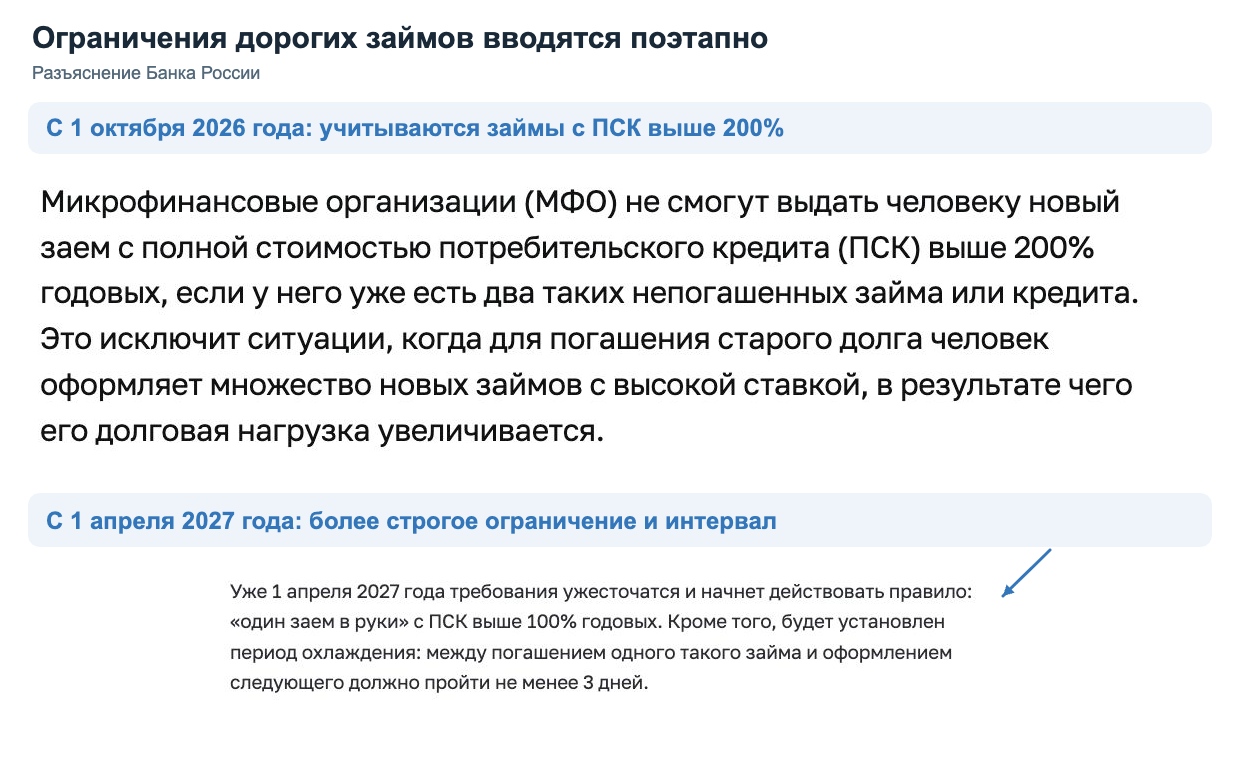
The Bank of Russia gives separate start dates for the October 2026 rule and the April 2027 tightening. A high-cost loan here is one above the relevant PSK threshold. The lender still assesses income and debt burden even when the statutory restriction does not apply. Bank of Russia guidance on lending limits.
How to look up an MFI by its taxpayer number
Start with the identifiers in the draft agreement or the website's legal section. An INN is more precise than a trade name. Several companies can use similar names, and a fraudulent site can copy another firm's logo and registration number.
- Open the financial market participants search on the Bank of Russia website. Search the Bank of Russia register.
- Enter the full lender INN and run the search. Use the state registration number (OGRN) if needed.
- Open the matching record and compare the full legal name and both identifiers.
- Check the status, the right to conduct microfinance activities and the current institution type.
- Compare the website in the register with the site asking you to sign the agreement.
- Save the record with the agreement so you can establish the status as it was when you applied.
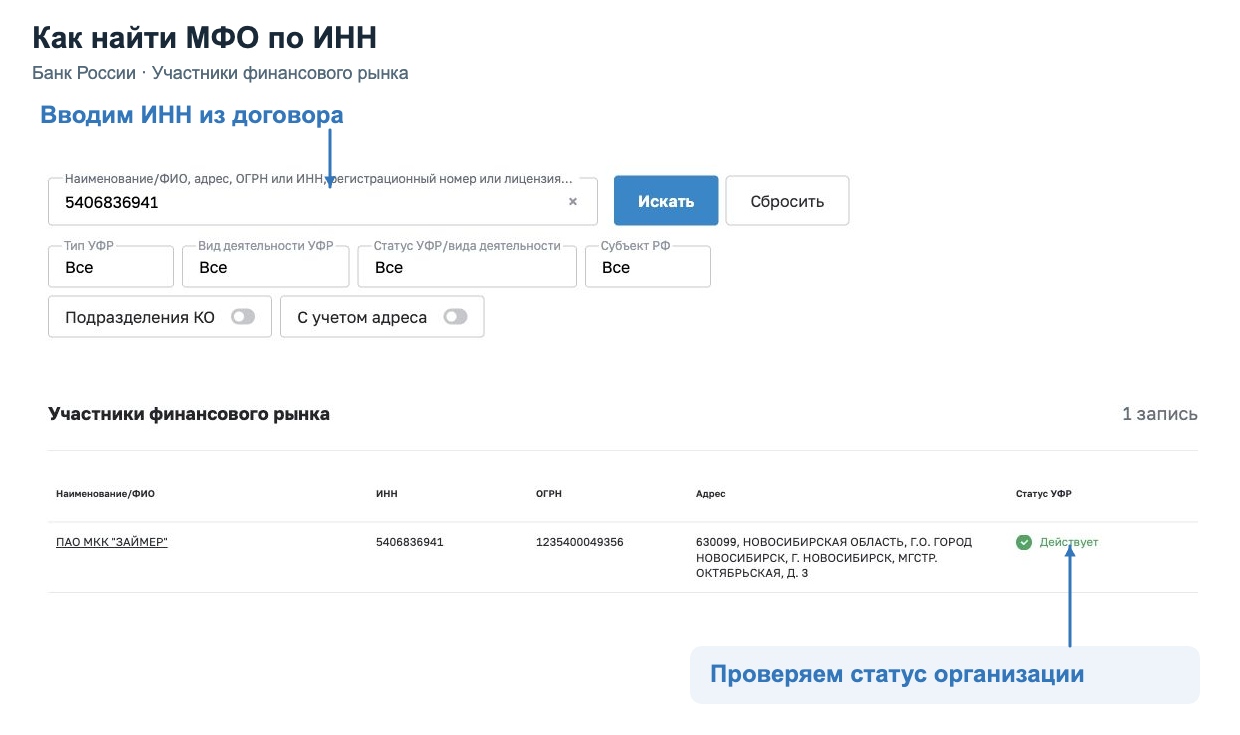
Worked lookup: Zaymer PJSC
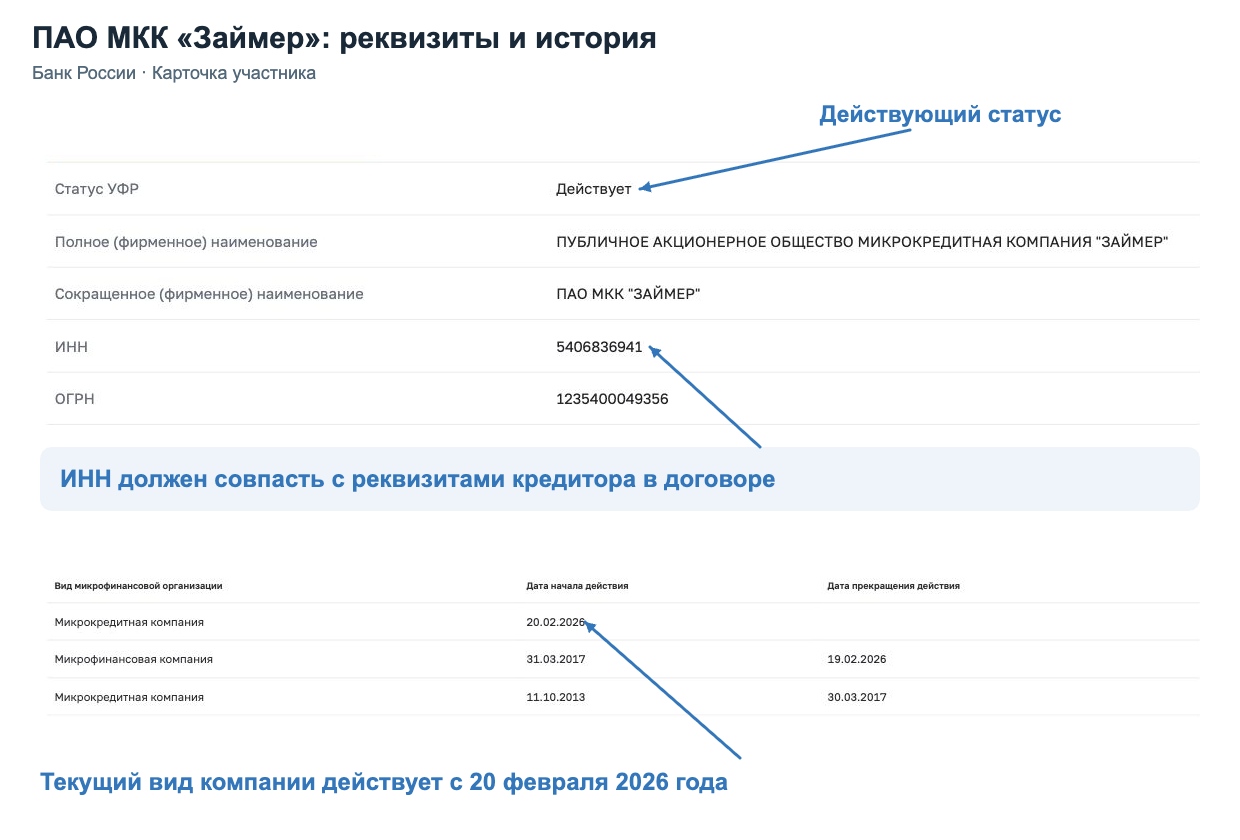
On 13 November 2026 a search for INN 5406836941 showed Zaymer PJSC as an active microcredit company with OGRN 1235400049356. Its microfinance activity is listed under number 651303532004088, with authorisation effective from 11 October 2013. Bank of Russia register entry.
The history below the record lists Zaymer as an MCC from 20 February 2026. The preceding MFC entry ended on 19 February. Older reviews calling it an MFC describe a previous status.
When the names match but the identifiers differ
Suppose a search finds an active company called Example but the contract shows a different INN. A shared name establishes no connection between the two entities. Search again using the identifier of the party to the contract and wait to sign until the discrepancy is resolved.
If no record appears, check for a typo and try the OGRN. Then consult the list of companies showing signs of illegal financial activity. Verify similar names against the domain and other details. An active authorisation in the register is still required even if the warning list has no match.
What to check before signing a microloan agreement
Find the individual terms first, including the amount, term, rate and schedule. Then read the general terms and documents for optional services. A phone may show only the confirmation button at first, so save the full package in a format you can read comfortably.
- Creditor. Do the name and INN match the register entry?
- Amount. How much reaches you and how much becomes principal?
- Price. What is the PSK as an annual percentage and in currency terms?
- Payments. How much is due and when? What happens after a partial repayment?
- Extras. Who provides them, what do they cost and how is consent given?
- Repayment method. Where is the fee-free option listed, and how long does crediting take?
- Contact. Where can you send requests and obtain confirmation of receipt?
Why the daily rate and total cost differ
The PSK is calculated under Law No. 353-FZ using the payments and timing it specifies. It appears in prominent boxes on the first page. The daily rate describes interest for each day of borrowing. Multiplying it by the number of days can illustrate interest, while the statutory PSK calculation depends on the agreement. Bank of Russia guidance on total cost calculations.
Offers with the same advertised rate can cost different amounts because of the schedule, principal, services that affect the terms or disbursement procedure. Compare the same amount, term and repayment method. Check the PSK and actual outlay. An optional service may be excluded from the legal calculation if it does not affect the loan terms, yet still adds to your expenses.
Worked example: RUB 10,000 for 14 days
Suppose you borrow RUB 10,000 at 0.8% a day and repay it all after 14 days. Principal stays unchanged and there are no extras, fees or late payments. Interest is RUB 80 a day and RUB 1,120 in total. You repay RUB 11,120.
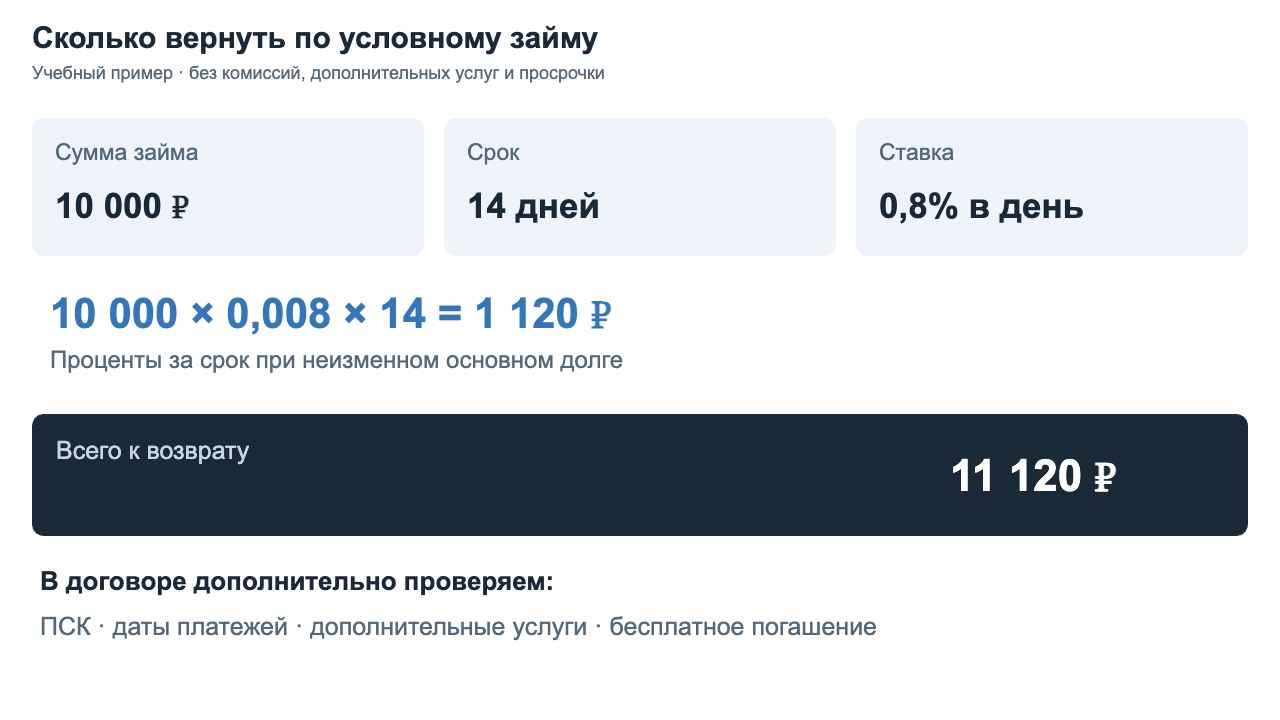
The calculation is 10,000 × 0.008 × 14 = 1,120. With instalment repayments, use the changing balance and payment dates. Check which days the actual agreement includes in the interest period.
Repayment and early settlement
Ask for the settlement amount for a specific date. A payment sent in the evening may reach the lender on a later day. The bank receipt confirms dispatch. The lender's statement shows how the funds were applied.
Article 11 of Law No. 353-FZ governs early repayment. During the first 14 calendar days you can repay a standard consumer loan in full or in part without advance notice, paying interest for the time used. Purpose-specific loans have a separate rule for the first 30 days. In other cases check the notice period, which the agreement may shorten.
After settling the loan, request confirmation that nothing remains outstanding. If you have a credit line, repaying the drawdown may leave the agreement and credit limit open. Check the closure procedure separately.
What to look for in MFI reviews
We looked at two public Sravni reviews, one about repayment and another about disputed extras. They suggest questions to ask a lender. Two accounts cannot establish overall market quality or the proportion of satisfied customers.
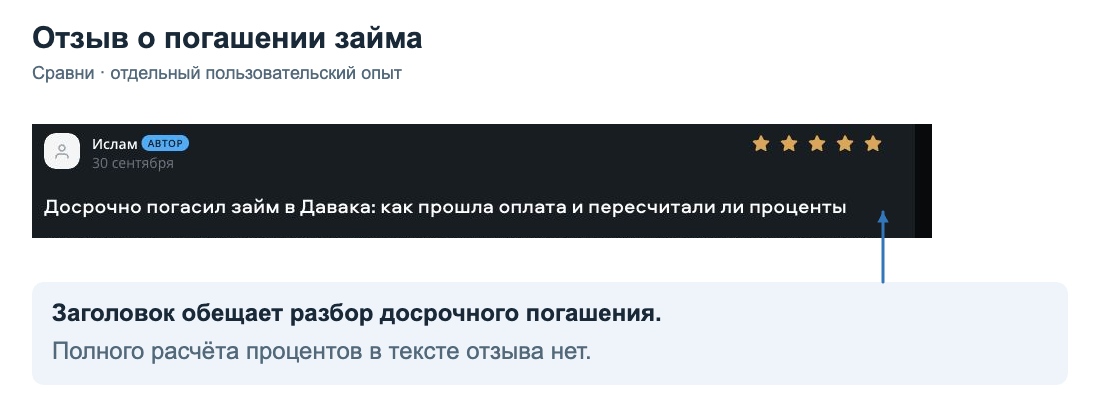
In a review of Davaka dated 30 September, the user describes paying via the Faster Payments System (SBP) and seeing a clear repayment amount in the account. The title mentions early repayment, but the visible text gives no complete before-and-after interest calculation. No year is shown. The user praises the displayed balance and payment crediting.
A review dated 8 November disputes charges and the terms of an offer for new customers. Establishing a breach would require the agreement, statement and surrounding facts. Ask which document sets out the discount, when it can lapse and which services are charged separately.
Collect details you can verify.
- The amount received and the amount debited
- The date used for the lender's settlement calculation
- Who received payment for the extra service
- When the request was filed and how the company responded
- Whether the final statement shows a zero balance
The Bank of Russia publishes examples of unfair MFI practices, including preselected consent, poorly explained paid services and notification problems. They help you read a contract and do not establish a breach by a company mentioned in a review.
Where to raise a dispute over a balance or debit
Contact the company first. Give the agreement number, transaction date and amount, and state what you want, such as a calculation, a payment correction or a refund. Attach relevant contract pages and receipts. Keep full passport and card details out of public reviews.
For an extra service, identify the provider. Services purchased with consumer credit and covered by Article 7 of Law No. 353-FZ have a 30-day cancellation period. Refund conditions depend on the type and the part already performed. For insurance, check its separate rules and whether cancellation can affect the rate.
Bank of Russia guidance directs consumers to the provider first. If the legal conditions are met, a refund can also be claimed from the lender. Keep the request date and response for deadlines and any follow-up.
The Bank of Russia handles compliance with financial law, and Rospotrebnadzor handles consumer protection within its remit. Monetary disputes may go to the financial ombudsman. Generally, the ombudsman considers claims up to RUB 500,000 against participating organisations, subject to Law No. 123-FZ and the applicable deadline.
Before approaching the ombudsman, submit a claim to the financial company and wait for its response or the statutory deadline. For disputes within the ombudsman's remit this forms part of the mandatory pretrial process. Consumers can file for free. The route depends on the claim and documents, and complex disputes may warrant legal advice.
How to compare MCC and MFC offers
Verify the legal entity first, then compare the total outlay. On small loans the contract differences usually matter more than the category. List the cash you receive, the due date, the amount due on time and the cost of extras.
Work out which income will cover repayment. If you already need another high-cost loan to repay existing debt, a lower daily rate alone may not solve the problem. Ask the current lender about changing the payment schedule and check eligibility for statutory relief.
If you want to compare a bank offer, check ordinary banking services as well. Branches and ATMs in the business district are listed in Banks and ATMs in Moscow City. If you repay through a payment service, see the guide to electronic wallets for how payment fees affect the total cost.
Questions and answers about MCCs and MFCs
Can an MCC or MFC operate without a banking licence?
Microfinance activity requires valid authorisation shown in the Bank of Russia register. A banking licence covers banking operations. To verify a microfinance company, check the relevant register and the exact legal entity.
What if the lender is removed from the register after issuing the loan?
Removal does not end the debt. Ask how to perform the existing agreement and who should receive payments. Verify the documents if told the claim was assigned. Do not stop paying or use an unsolicited link solely because of news that the lender was removed.
Can an SMS code sign a loan agreement?
A code can serve as a simple electronic signature under the applicable rules. Before entering it, read what you are confirming and what follows. If a stranger asks for the code by phone, end the call and contact the company yourself.
Do I owe the matching service if the loan is declined?
The separate intermediary agreement can charge for matching or a subscription regardless of the lender's decision. Check what it provides, how often charges recur and how to cancel. A promise to find an offer does not make the intermediary the lender.
How can I confirm repayment reached my credit history?
Keep the settlement confirmation and request a credit report from the relevant credit bureau. If the information differs, contact the lender and the bureau with supporting documents. Deleting the app or seeing the payment button disappear does not establish that the debt is closed.